FMP - Research, Prototyping, Testing and Iteration
- Irene (Shiyin Zheng)

- Nov 6, 2019
- 4 min read
Updated: Dec 11, 2019
Relating back to the research
Continued with the design concept, I related back to the research. In the research, I concluded the elements that people will use to shape space-related memories – pictures, stories, sounds, smells and other senses. I was not building components for each of the elements anymore, but instead, I included them as categories in the recording process. People are not remembering as what current data forms are. We are not storing images, videos or recordings in our brains but pictures, stories and other senses. Thus, I tried to redefine the memory elements and get away with the existing classification.
Research around similar projects
Speaking of space, memory and AR, there is SaraGEO, the idea of a map album combining google maps and instagram together. Nevermind, combining the memory palace method with augmented reality to create a tool to help anyone to memorize effectively. Rememball, using AR to place video in the place, targeting at parents and children. Spatial memory AR app, evaluating the spatial memory of object locations in a realistic and actively navigable environment. Moments, a prototype designed for users to save special moments and to experience those moments in the future. Tango, a technology that utilizes motion-sensing and depth-perceiving cameras to turn a mobile device into a “wayfinding” and Augmented Reality (AR) powerhouse.
Speaking of existing AR applications, I downloaded most of the popular AR apps in the app store to research about how they use AR. There is Just a line for drawing spatial lines in the space using AR technology. Sketch AR, using the wall in real world as a canvas to learn drawing. Bigbang AR, telling the story of the universe using the real world as a background. Candide Labels, recognising plants and adding digital labels to them. After saving the area, it can recognise it again and allows revisiting the labels. AR Moon, creating the immersive experience of landing on a moon. Enter the room, telling a story by creating a virtual room in the physical world.
Most of the AR applications are using the technology to create an experience or tell a story, and they do not relate the digital world with the real world closely. However, since AR cloud is coming to birth, more applications start to connect these two worlds together. My idea is also in this direction.
My idea is similar to Rememball, which connects the memory and the space. But it is limited in videos and focuses on vivid replaying, while mine is more towards emotional need, and goes through time. The technology of my idea, which contains space and objects recognition, is similar to Candide Labels. The existence of it proves that my idea is doable.


Prototyping and Testing
Test 1
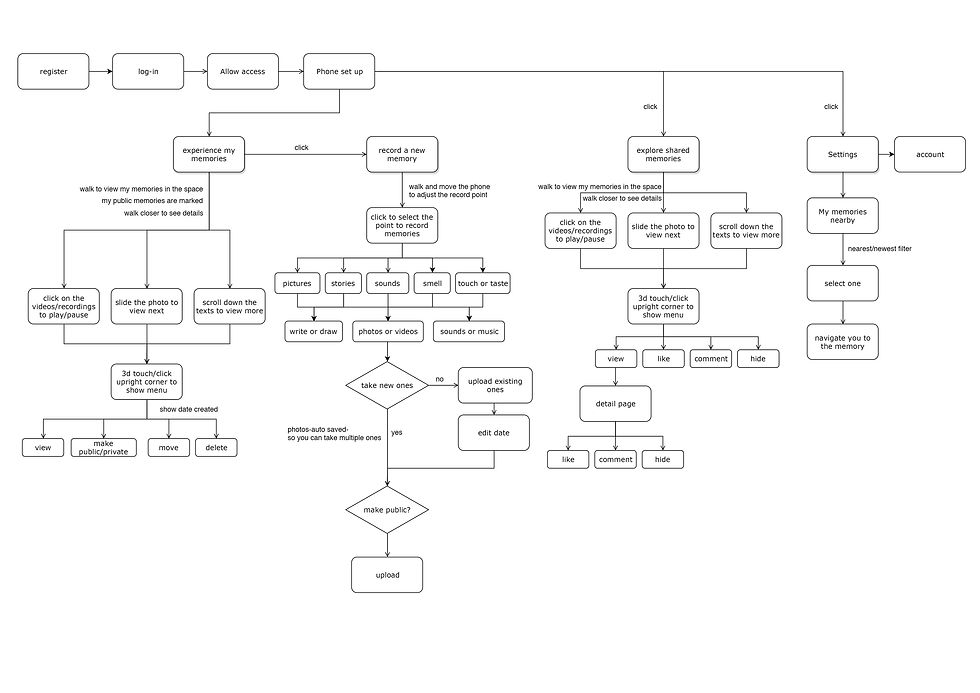
I put the application into two main sections, one is for recording and the other is for viewing memories. I supposed people are willing to share memories and every memory recorded will be seen by others. Based on that, I prototyped the first version and did the test among six target users.


I gave them the scenario as a graduating master student wishing to leave some memories in the classroom for future reviewing, and providing them with the prototypes to use. By doing this, I tried to figure out the following questions:
What would they like to record and by what forms?
Would they want everyone to have access to their memories?
How long would they like their memories to last?
Would they be interested in viewing other people’s memories?
From the test, I found that:
Most participants would like to record their great time with classmates. Memories lasting forever will be preferable.
Texts and drawings are not enough, they would like to videos and photos as well.
Memory is still a personal thing. They tend to share memories only with people involved in the memories or people in close relationship.
Similarly, they are only interested in memories from related people, such as classmates or last-year students, and one reason is that these memories may trigger their own memories.
Based on the findings, I added photos and videos as other forms, and separated the individual and public memories. I moved the viewing public memories into a separate entrance as “explore mode” . The application is firstly a personal memories’ recording and experiencing tool in “my memory mode”, and then a shared memories’ exploring tool in “explore mode”. Rather than sharing recorded memories in a default way, users can choose to make them public or private.
The application supports emotional needs. It provides the possibility of leaving digital marks in the space over time until you are back and dig them out. Meanwhile, because users have to be in the space where stories happened to view the memories again, the recalling process will be more vivid. It may also enable users to be think about the importance of space.
Test 2
After developing iterated high-fidelity prototypes based on the above knowledge, I tested details of the design and varied visual styles. I provided the prototypes and different visual versions to five participants and found out following things:
The locating icon was hard to understand and a hunting target icon is better.
It was confusing to see the page of “choose the type of the memories” and a popping-up instruction is needed.
Most of the participants preferred the coloured regular-shape version compared to hand-drawing or mono-coloured ones.


Comments