FMP - Field Research
- Irene (Shiyin Zheng)

- Oct 15, 2019
- 6 min read
Updated: Dec 11, 2019
For my field research, I aim to understand how human brains remember a same shared space differently in a qualitative way. Rather than a cognitive focus on how memory reconstruct over time, I focused on the richness of people’s memories.
Methods & Why I chose them
Because memories are such subjective things, it may be hard to describe them merely in words. Thus, I designed two different tasks to get participants be more articulate. I prepared artefacts to ask them to produce something as well. This can help them to express their thoughts more freely. Apart from these, I did the observation to get myself better understood with the background of their descriptions. In conclusion, I adopted behaviour mapping as a method of observation, interviews and draw the experience as other research methods.
The whole research was divided into three days, and fourteen people in total participated in the research, thirteen of them produced sketches to describe what their memories are towards the canteen.
Because of the limitation of time, I only conducted the research in one chosen space. I took the canteen of Camberwell College of Arts as an example, because for one, it is a typical shared space within colleges where students have different space-related memories. For another, it is a space in high-frequency use, and it contains multi-sensory experiences, which is more likely to shape rich memories.
There are two ways to retrieve people’s memories. One is ‘bottom-up’, meaning ‘encountering one of the elements making up the event’, such as seeing an object or smelling a smell. The other one is ‘top-down’, for example, by asking a question such as what were you doing last time when you were here. As I did not know what people’s memories are, I used the second method to retrieve participants’ memories towards the space.

Observation using behaviour mapping
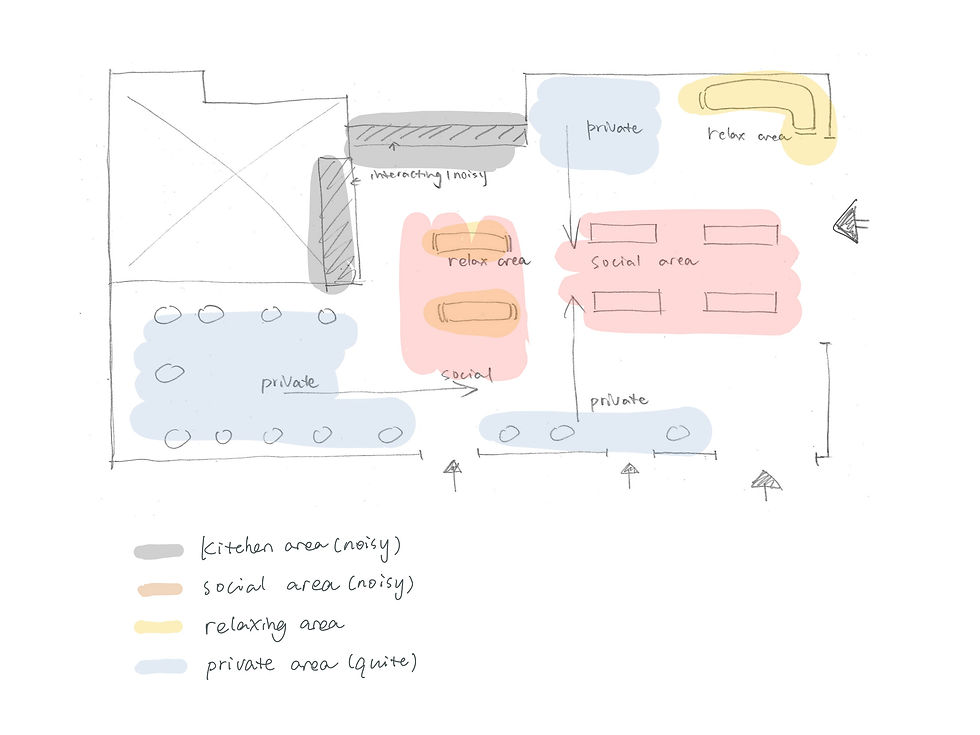
I did the observation during three states, including the crowded lunchtime, less crowded afternoons and quiet after-school time. I found that the space is not merely regarded as a canteen, but as a place for studying, socialising or killing time (see picture below). During busy hours, most people are heating food, eating or chatting in groups; During quiet hours, people are mainly studying, listening to music or waiting for friends alone (see picture below). Central areas are where social activities happen. While alongside the wall and windows, people are mostly sitting individually, either studying or eating. The space is quite noisy, and there is always the background noise of the pipes. But the warm lights from the ceilings bring much comfort.


Interviews
I listed things I want to know and prepared interview scripts in advance. I also showed the scripts to Mor during one tutorial and she gave me some advice on the questions.
A. Welcome and introduction
Hi, thank you for taking time to participate in this interview. This is an interview for my final major project. The project is about memory and I am trying to explore other ways to record space-related memory, rather than simply using photos or recordings.
The interview contains some basic questions and two small tasks. It is about how you memorise Camberwell Canteen. Before we begin, I am going to give you a brief overview of the interview and how it will work.
It’s really important to know that you cannot do or say anything wrong here. Please feel free to let me know at any time if there’s something you like, dislike, if you’re confused, etc. I promise you won’t hurt my feelings. If at any point you have questions, please don’t hesitate to ask. Do you have any questions so far?
Is it okay to record while you do the test?
B. Background information
1 Where are you from?
2 Can I ask how old are you?
3 What are you studying in?
4 How many times have you been to Camberwell canteen?/How familiar are you with the canteen?
5 What is your feeling towards the canteen? (Mor: What do you feel when you are there?/ What is your association with it?)
C. Ways of remembering the space
1 Would you miss the place after you left?
2 Have you tried any of the methods for remembering the place?
3 If so, what methods have you used?
4 Ask about the detail/the story behind.
5 Have you ever taken a picture of the place, because you want to remember some specific moment?
6 If so, do you think the picture helps with recording your memory of the space?
D. Activities inside the space
What do you usually do in the space?
Can you share a story with me?
(How are you connected with the place?)
E. Tasks
I designed two tasks in this part. The first one is to let them search for the space in their minds, and the second task will be explained in the next part “Draw the Experience”.
The scripts of the first task are as follows:
In this task, I’d like you to “think aloud” as much as possible. By that I mean that I’d like you to speak your thoughts as often as you can. Also, I’d like you to be as sensitive as possible, free yourself and use full of your senses.
I would like you to close your eyes and try to search for the space in your memory, or say, think about the memories you have with the space. (Pause) What is the first thing coming to your mind? What else?
Try to describe everything you think about in detail. If you found it cannot be described in words, you can also draw it out or sing it out.
Does it have a smell? What did you hear? Does it have a particular smell? Are there any activities/ happening? Does it have a colour? Do you have a specific mood?


Analysis and results
I translated the interview recordings into scripts to analyse. Because the information is quite straightforward, I only labelled it with one colour to highlight interesting parts.
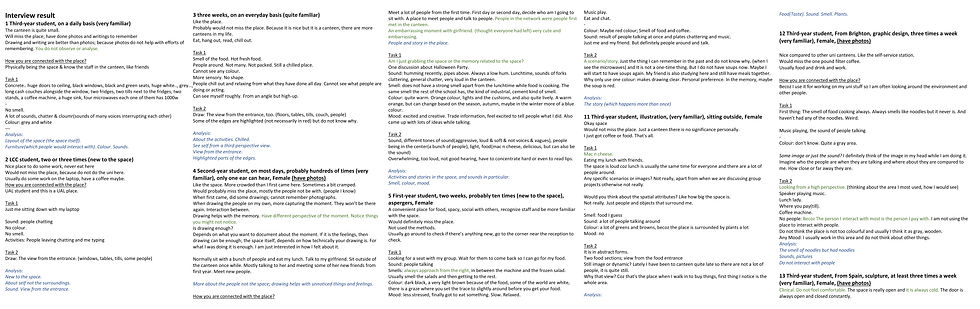
I found that there are two types of participants:
More physically connected with the space. Those people would remember the furniture one interacted with more than the space itself. Those people might often come to the space alone, and people who are new to the space are mostly this type.
More emotionally connected, either through the staff or great time with friends in the space. Those people would mostly focus on the stories they had or the staff in the space they know. For example, there is one participant said “When you asked me about the space, the first thing I think of is Danis (one of the staff). ” (see picture below)

Based on that, I also found out the following things:
When I was using a question to retrieve participants’ memory towards the space, I found that they are mostly using sounds, smells (different senses) or emotions to sense and remember the space.
Participants rarely mentioned the details of the space, it is more like a container. What is happening inside is more important to them.
Space itself also serves as a container for the memory, and participants used it to remember related things.
I further categorised the elements they mentioned to describe their memories into a table. According to the sequence of the elements each of the participants mentioned initiatively, I painted the corresponding boxes with colours from darkest to lightest. By this I wanted to figure out the most important elements of recalling space-related memories.

I found that pictures, stories, sounds and smells are the four most used memory elements. By pictures I mean static images or scenes, such as a picture of autumn leaves underneath footsteps with sunshine from the top of the head. By stories I mean episodes or plots which contain sequences of events, such as “my friends and I went to the supermarket but we soon found we forgot to bring money”. Sounds and smells are also important in constructing a memory towards a space, however, smells are still hard to capture with technologies. This finding demonstrates that digital forms such as photos and videos are not how our memories should be described.
Draw the experience
For the second task, I provided participants with the same set of tools, including a cutter, a glue stick, pencils, coloured pens and white papers. The purpose is to let participants draw or make how the space exists in their memories. I expected them also to make something instead of simply sketching, however, none of them did that during the first day, and few of them used colours. As a result, I changed the task into sketching only and asked them to feel free to use colours. I tried to describe the task as open as possible:
I would like you to draw the space in whichever the way you remember it. Feel free to use as many colours as you want and feel free to sketch up whatever perspective you want. You cannot make mistakes. I just want to know how you sketch it.
Following this I asked further questions around their sketches, such as “why you drew that table in particular”. By this I want to look into how they remember the space in a more explorative way.


Analysis and results
I collected thirteen sketches in total. Most of the people drew the long tables (see above) because the tables are conspicuous and even become the representatives of the space. In addition, according to the observation, those tables are in the middle where most social activities happen, and this may lead to the connection with the space through stories. Another interesting finding is that plenty of people are drawing from a high perspective, which does not actually exist because we never view space in that way. In the sketches, participants also connect their personal feelings towards the space, for example, one of them sketched the canteen as a very long, endless empty space, because it makes her feel uncomfortable and restless. However, the colours they used did not really have particular meanings, mostly only used for distinguishing one thing from another.


Comments