Design directions
- Irene (Shiyin Zheng)

- Jun 4, 2019
- 4 min read
Continuing our direction as cooking experience, we did some further research and came up with two initial ideas this week.
Further research
First we did some research around cooking for design opportunities.
Interviews
We first did some interviews and asked people about their cooking experiences. Some people expressed the value of cooking together in terms of the conversations or stories they shared. They expressed that they would like to explore cooking with strangers especially when they are like-minded and can share similar food interests. Therefore, when people exchange food, they exchange not only food but exchange valuable information about each other from their likes, dislikes to their personality. It’s like sharing a social relationship.
I have no one to cook with. Having a conversation or a laugh while cooking is nice, would like to cook with others. -Lisa, 23
When someone invites me for dinner, as an exchange I bring wine, appetiser or see the menu and get something to complement it, It’s about sharing a social relationship. -Pat, 25
Practice review
We then looked into some practice review about the organisations already doing work in this space. We looked at organisations like FoodCycle, Food Pioneers and Mission Kitchen. FoodCycle is a UK charity that combines surplus food, spare kitchen spaces and volunteers to serve community meals across the country. Food Pioneers is a social food enterprise working with local, regional and national partners to build community through shared food experiences. We emailed some of the organisations in London to see if there are any opportunities to do some research at the site or have collaboration with them, but none of them replied.

A small test
We did a small test to understand the flow of people for cooking with others. We created a new method for testing flow of people cooking with others with provided options and arrows. There were also blank ones which they could write on. We also added options for other questions to find out where people would like to get ingredients and who they would cook with. However, it failed because we were testing too many things at one time. It turned out that too many answers were mixing together and the results were not useful.
But still, we found that usually people prefer to cook with friends, because they do not trust strangers on cooking. If it is for other aims like making friends, they are willing to try it.


Initial ideas
Brainstorming
Based on the research, we did a brainstorming on two design opportunities: "cooking with people socially" and "how to co-cook with others from different locations". The first one is more practical and for the second, we pushed it towards the future and became more crazy.

For "cooking with people socially", we thought about a community producing food and recycling it itself, a online platform for sharing cooking stories and etc.
For "co-cooking with others from different locations", we came up with crazy ideas like seeing the other one's moving trace while one is cooking in the kitchen. I made a concept image to show the idea. However, we thought the idea too crazy and gave it up.

Two initial ideas
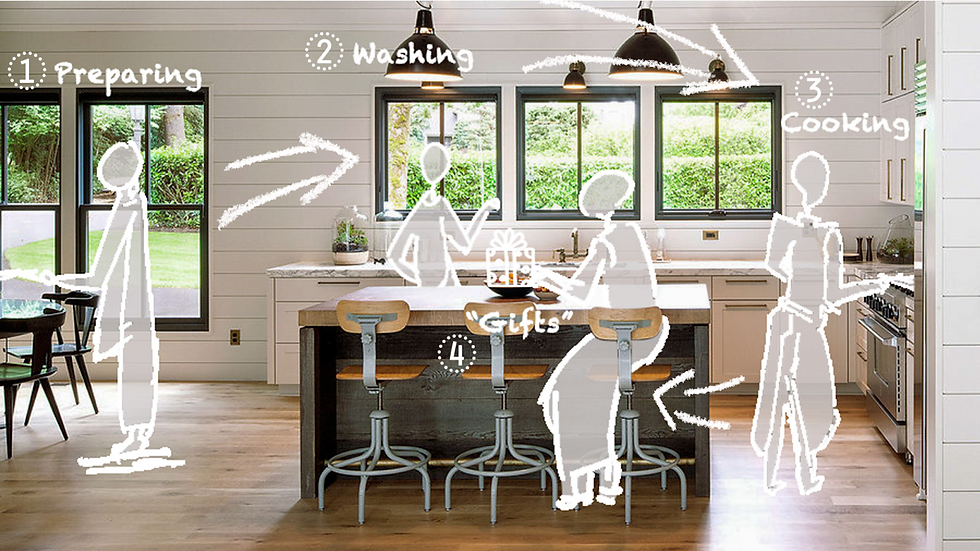
1
A shared kitchen space for people to cook incorporating the Gift Economy.
Receive gifts - Learn new things - Leave something behind
People can share this kitchen together or use it individually. Besides, we added a concept absorbing from "gift economy", where people can leave a "gift" behind in the kitchen for others. The shared kitchen provides an opportunity of exchange.
The advantages of a shared kitchen are:
Making meals together means that you’ll have to power fewer kitchens, meaning fewer carbon emission
By pooling resources you cut down on waste, and it’s a great opportunity to explore new foods too whilst having fun with friends.
It is not all about cooking, it is more about relationships, atmospheres, cultures, stories and human’s values. We added another layer to the shared kitchen.
2
Digital table for sharing recipes
There are lots of concepts that showing the behaviours or interactions might happen in the future, like the IKEA future kitchen.
Our research shows there are some needs for people to share their recipes, for example, the students study abroad might want to cook some food that have the taste from their family. They often call their parents or grandparents for help, so the digital table offers an opportunity for people to personalised their own recipes and make it visible. And we also find that there are lots of communications or sharing happened while people are cooking. The connections can still exist even if you are not with each other because of this digital table.
The advantages of the digital table are:
To keep people connected even if they are not with each other
Personalised recipes and aid food related conversations


We presented at Made by Many with two ideas and they prefer the more practical one, the shared kitchen. So we continued with that idea.

Reflection
When we got the idea of seeing the other one's moving trace, we were frustrated because we felt unsure with continuing our ideas. Our brief is about abstract value and our idea was also abstract, too, and we cannot get it into details. We talked with John on Skype and we found that we should flip over. We were going from abstract to real but we should go from real to abstract. Abstract things are based on real things, so does the digital things. So we started again by looking at a real meal, a real kitchen and how people interacted with them, then we go towards the digital recipe and digital kitchen.
For the failed test during the research, I learned that we should test one thing at one time and before doing the research publicly, we should test the research method out carefully as well.


Comments