Final Design Outcomes
- Irene (Shiyin Zheng)

- Jun 20, 2019
- 4 min read
In the final week, after we found that we forgot about the big picture after presentation, we did a test as well as a video for the cooking and eating part to make the value exchange explicit. The complete design outcomes will also be shown below.
A test for the cooking part
We asked two strangers to get involved with our cooking and eating part, and two of our teammates also attended. The test starts from buying the ingredients and ends in eating. The participants were from different culture and they wanted to try either Chinese food or spicy food, so we mocked up a hot pot test for them. We wanted to see how people would react to the journey and how the value would be exchanged during the process. We then made a video out of it also for showing our concept for the second part of our journey.
Final design outcomes
There are two parts of our service: one is the part for finding a co-cooking partner, the second is the actual experience of cooking with people. The consideration for the first part of the design was to create something interactive and fun that attracts people. Whereas for the second part for the actual experience we decided to have a shared kitchen space in UAL for two reasons: 1. a common space would help to establish trust in meeting new people 2. be beneficial for students with limited resources

First part of the journey
In detail the journey of finding cooking partners is as illustrated below. People would be attracted by a digital interactive ground in public space in the university, and they could scan a QR code and sign up with student ID, course and gender (the information we got from our initial research). The service would then be browser based where people would type in their messages. They would then shake their phone to add a new fish to the ocean. While for receiving messages, users can first set filters on their phones and corresponding fish would come near. They could tap the phones on a sensor to receive messages and a fish would be removed from ground. It is possible to achieve this and we made a concept video for this part.

Second part of the journey
The steps for the second part ranged from buying ingredients to meeting in UAL shared kitchen, preparing ingredients, cooking and eating together.
As said above, we did a test for this part and we recorded the entire process analysing the discussions to the way the entire collaboration took place. We also highlighted the value exchange process during the video. We asked about the participants' thoughts after the end of the journey and it was included in the video as well. We hope that the system helped in facilitating value exchange in a fun way.
The thing I found interesting in the test is that people bought ingredients individually (containing different personal values) but when they met and shared the ingredients, their personal value jointed together by conversations of personal tastes and etc. Similarly, while they were cooking or eating, they were constantly exchanging their personal value. When they finished eating and were about to leave, joint value again went back to personal value and people took their new personal value with them.

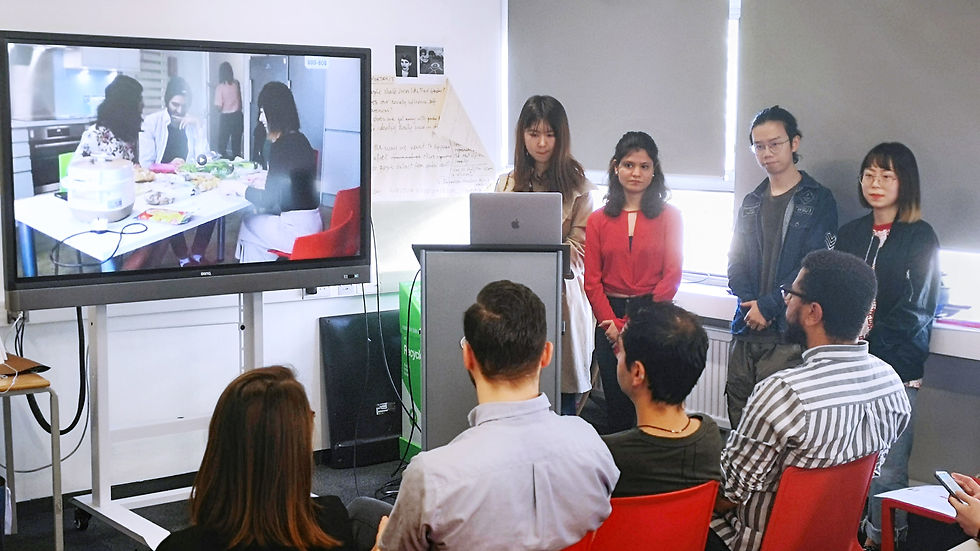
Feedbacks and learnings
Where the value exchange happen is interesting. Value contains in the learning and also the negotiation parts in the process. Exchange happens first and value is in the end.
The isometric illustrations present the journey well.
The digital ground thing is an interesting and fun way of onboarding people in physical space. It does not rely on traditional messaging products design.
One thing missing from the second part: explicit methods about the exchange. We relied on people's behaviour while cooking to create implicit way of exchange, but we need a way to structure the interaction in order to make the exchange clear, like what is happening here.
Make what is happening in each stage and what value is being brought explicit; Make them as an output, for example, what is person one's learnings/value and what is person two's. Make the things video implied explicit.
Ways to make a service tangible: think about the stages happened in the cooking, like whether to keep the photos, where to find the space to cook and what you want to share with others. Then it would become really rich and we could do much specifically.
We missed some micro attention. For example, in these scenarios, we can pay attention to where people sat, and people cannot actually cooking together, maybe notice how people gather around the chef and etc. Pay more attention to the details and micro things.
Some existing organisations: first social cooking then go to the idea of training.
Reflection
Although we adjusted our design and expanded it to a bigger journey map, we missed the micro aspect of our design. I feel that we did not balance well between macro and micro, and we should have emphasis “value” before we went into the micro stage.
The videos may not communicate everything. We still need some graphs or illustrations to make the things (like how value is exchanged) more explicit.


Comments