The UX of Urban Space: Behaviour Mapping
- Irene (Shiyin Zheng)

- Nov 5, 2018
- 3 min read
Updated: Jan 3, 2019
The UX of Urban Space
Team
Lara Biagini
Yu Qin
Dark (Yaqi Meng)
Jing Zhao
Irene(me)
Place
St Mary's Churchyard
Workshop
I grouped with Dark in this workshop with Grace. We got some tasks to do, as shown in the picture. We also collected what we thought as representatives of the park.

Generally, it was a park with entertainment facilities and a big lawn. We measured the size with the time of walking from one side to another, and it took about 1 min from a straight route and 2 min from a indirect route. We found that there were three types of people in the park. The first group were children, who played there mostly in groups. The second group were parents, most of whom were here to accompany their children. The last were others, like the passers-by.


We did some interviews as well to ask their opinions toward the park. For parents, the main reason they chose this park was that it was free of charge. But both the parents and the kids liked the park a lot. One kid even used our pen to draw the following picture to show how he was in love of the park.

One thing we found interesting was the fountain in front of the facilities. The fountain was not high, making it easy to get itself interacted with the children. However, children would get wet after playing with it, which may cause a cold. So we collected water as the representative of the park.
Interested Topics
The workshop and what we discovered were impressive, and they laid the foundation of our following project. Again, we agreed on choosing the place after showing the park to the other three team members.
We went to the park again together to get some basic information, and then we came back to write down what we saw on a big paper. We discussed a lot for the following things.

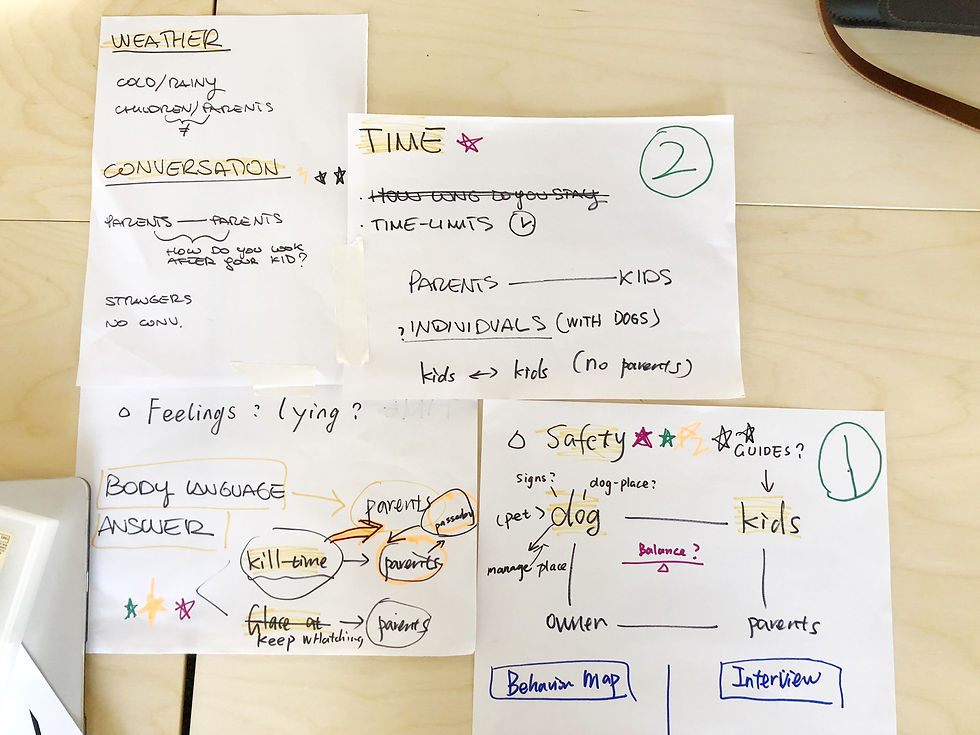

We decided on focusing on the relationship between the parents and the kids and listed out what could be design opportunities. Then we divided us into 2+3, for the "interview" method and "behaviour map" respectively. Jing Zhao, Dark and I worked together on the behaviour map. We also listed what we could do in this method, as the notes in the picture shown.
Behaviour Maps
We made three behaviour maps in total.
The first one is to show the background of the park, like the sunshine, the location, the environment and the streamlines of people.

There is also a physical model to show the park. The whiter columns are representing parents and the smaller columns means the kids. Basically, parents and kids are distributed mainly around the entertainment facilities.
What is interesting is that parents tend to gather around the corners, while the kids are most in the middle area. Another interesting thing is that most parents are singles while kids are in groups even though they do not know each other.
Another finding is that there is an invisible connection between the parent and the kid. We made a further model to illustrate it.


A Magnify Model
Focusing on the string, we made a magnify model to show the relationship between the parents and the kids. String means parent’s sight direction and these two’s distance variation. The curvy line is kid’s playing pathway. The sight of parent would change as the kid plays in different directions. The distance between them is also changing. However, there is a limit to the rubber band, just as to this distance, which we can call that a safety distance. But who defines this safety distance? Safety is a subjective thing, and it is perceived differently by different people. Can we make the safety distance extend longer through our design?

The Storyboard
We also made a storyboard, telling what one pair of mom and her kid would be doing during a certain period. It could be unfolded one image after another, just as how a story is told.


Benefits of Making A Model
Speaking of the model, from the feedback of the presentation, I learned how to reflect through making the model. For example, we could think about the material of the model. We used a rubber band to show the relationship, but could it be a tenser one or looser one according to different types of parents? Furthermore, what causes these different types, the culture background or what? We could ask us more questions by looking at the materials of model we used and by the elements in the model. Thinking from that and find out more. However, if we did not make a model, we would probably neither think of these aspects nor think in a logical way.


Comments