The UX of Conversation: Bot Ally
- Irene (Shiyin Zheng)

- Oct 27, 2018
- 4 min read
Updated: Jan 4, 2019
The UX of Conversation
Team
Yixuan Wang
Beibei Li
Deepika Grover
Irene(me)
Chatbot Workshop
The workshop was quite useful in the technical level. I learned the basic knowledge of building a chatbot, and I learned to pay attention to things I ignored before. For example, the personalities of the bot, consisting of the gender, tone voice, appearance and etc. There should also be a pull/push, which means who should initiate a conversation.
I built a conversation using the "storyline" tool.

Based on the workshop, we did some user tests using our storyboards. Several things surprised us. Some people said the voice of the chatbot could take from some famous chefs, but they also liked the non-sexual avatar we were using. About the conversations, all most everyone believed continuous questions were annoying, sometimes a direst suggestion could be more helpful. We also found out that most people were in need of recommendations of the recipes on base of the current materials, instead of having a recipe before buying materials.
How We Decided Our Topic
As I have mentioned, we separated in the research part in the first week, so we soon met some problems in the following week.
We had distinct research findings from two research methods and it took us a long time to choose one design opportunity.
Because of the time limitation, we had to decide and move on, and at first, we rushed to the topic - which was concerned with each of us - helping us with hometown recipes when homesick. The bot could detect people's emotions, call the mom, record and take down the recipe and then teach the user how to cook.
However, after the tutorial with Alaistair, I felt that we were kind of generalising the situation. One thing was that sometimes people were homesick not just because the specific taste. It could be more of the specific situation you met, or the time you valued. As a result, even the taste was exactly the same (which was also nearly impossible), other things could still be missing. Another thing was that while the bot was helping you with calling and recording, human's value was gradually missing. The call was actually a good chance for the user relieving his miss towards his mom, but now the bot did the call, recorded the recipe, simply intervening into the process and ruined this by flawless and cold actions. It reminded me to think about where the human value was when more and more technology was taking up our life. Is it really helping or is it ruining our life by taking the emotional part away instead? How to balance these two things when we were designing and to what extent? We should really be careful about whether we had made similar mistakes when designing.
Later we thought more about the drawbacks of the technology and figured out a new script telling the story of a bad-designed chatbot. At first the user was enthusiastic about the bot and used it to analyse calories, order foods learn cooking specific foods. Gradually, the bot knew the user Jane better and began to restrict her ordering times. The bot became more and more like Jane's mom, which made her annoyed a lot. Finally when one day the bot Ally recommended ordering a salad instead of a pizza, Jane got entirely bothered and threw the bot away.
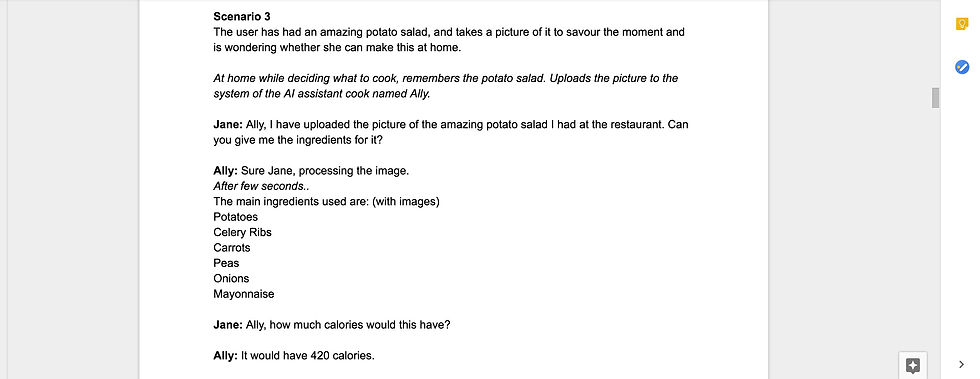
https://docs.google.com/document/d/1QuxI9l5BfovfCSjTDG58B30rBle7ujxPeuBf8DeL0go/edit?usp=sharing
We intended to use different conversations at start and after one year to make a contrast, and arouse people's thoughts about how we designers could avoid this.
Working On the Presentation
In the following days we worked on the presentations. I lent a projector from the Kit Room, Yixuan and I decorated it with ears and eyes, as if its eyes were actually projecting pictures to the wall.

I took the video of how Jane was excited about getting Ally in the beginning.
Also, I made a prototype using "Principle" and "Sketch", indicating how Ally worked with phone.
Then Yixuan and I made recordings in advance in a quite room upstairs, using a system voice called "Kate" on the Mac, and we two divided the recordings into ten pieces using the software "Adobe Audition".
We also made a keynote projecting from Ally's eyes, and practiced the acting part. I acted as Jane.


Presentations and Reflections
The presentation did not worked well. One reason was that we used too many media, which caused confusion to the audience in the short 10 minutes. They were still trying to understand last scenario when we were already acting the next one. The other reason was that we wasted too much time on the discussion and we did not develop the idea well.
Looking back on what we have done, I felt that we focused too much on telling a big story instead of one detailed conversation. We should have brought forward this in the beginning of our design but we did not. What's more, there were many design opportunities we missed, like how the bot established the relationship with the user (there could be tons of interesting stories behind it), or how the stories went when the user was unhappy with the bot. We could even just focus on the calories counting thing, like building up nutrition diets. The thing we found difficult or not smooth enough was probably where the design opportunities were.


Comments