Field Research: Co-Sleep
- Irene (Shiyin Zheng)

- Jan 31, 2019
- 3 min read
There are many sleep products on the market that try to improve sleep health. Dreem, along with sleep health organisations and competitors aim to improve understanding of their sleep health using technology. There are many interesting insights about sleep throughout history that are neglected by modern scientific understanding. For example, the existence of watching periods, and two period sleep is not commonly acknowledged. Societally imposed schedules affect our sleep health greatly, since the creation of the light bulb. What are the outlets of sleep that we can explore that Dreem may not have considered?
Deciding on the sub-topic
We concluded things we can use from our previous research into four fields, neurological, environmental, historical and social and raised questions to get us inspired. Dreem has done a lot to explore the science of sleep, and our approach is to find a position in social and cultural context which Dreem has neglected.
We brainstormed about "sleep+" and synthesised them into larger categories.
Deciding on topics:
1. Sleep + Relationships: co-sleep
2. Sleep + different context: sleep on the go/sleep in hotel..
We voted on the topic and chose "co-sleep" as our sub-topic, which turned a personal thing into a dynamic and integrated system. This is also missing in the current market.
We realised that sleep as an activity is an intimate and social one, not just simply for an individual. We wanted to explore how sleeping with others will alter our sleep habit and health. What we are suggesting is a paradigm shift, from designing for a single user to a plurality of users interacting users.
But at this time, we do not limit the partners into "people" or "objects". We tried to open the questions to get more interesting design opportunities.

Field research
We conducted both qualitative and quantitative research on individuals who have experienced “co-sleeping” through surveys, interviews and card sorting.
Surveys
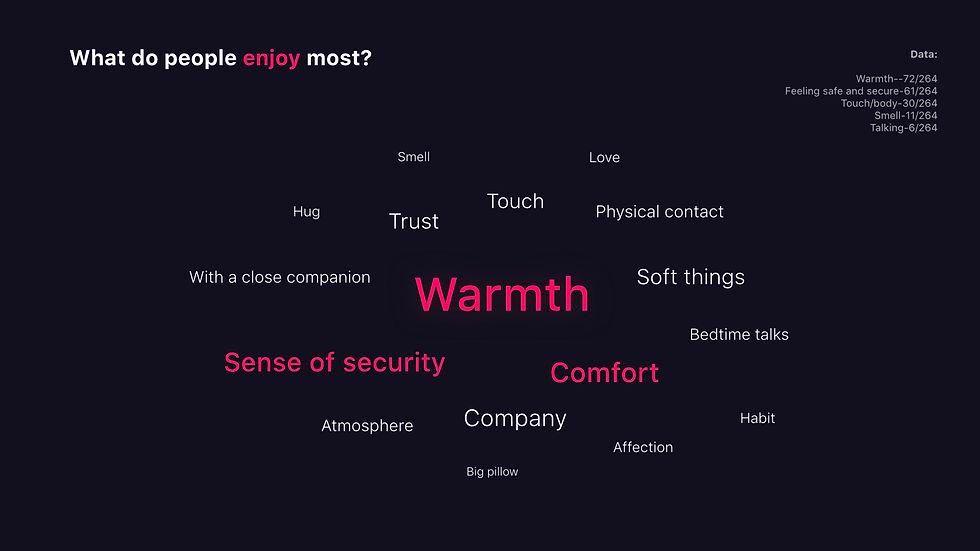
We created an online bilingual questionaire and got 264 participants.



Interviews
We conducted many interviews both in person and on the phone with persons living in a co-sleep habitat. We asked them to describe to us what their bedroom setting is, how they sleep next to their sleeping partners and how they think they affect each other.

We also asked them to draw what their positions were while sleeping to help us understand their words. However, it turned out that we could not take the answers seriously because most of them did not know how they were like while sleeping and the drawings were quite random.

We then combined our interviewees in one list to see whether the diversity of the group was enough.

We asked the permission for recording and I translated the recordings into scripts. I coded the scripts into colours to analyse from the words.

Card sorting
We wrote down things associated with sleep that we found from the survey on post-it-ons, and asked people to rank them according to the affinity. Then we concluded the outcome in one affinity map.


Findings
Some people enjoy pre-sleep conversations as a form of closure
Some people have preconceived expectations towards co-sleeping with a partner
Some feel self conscious that their own sleep habits will affect others.
Pets can both enhance and dictate our sleeping habits
Toys are an interesting part. It can be used for varied ways while sleeping. Toys are associated with “rites of passage”, and nostalgia but not necessarily a desirable object in itself.
Women are generally more affected by their sleeping partners
Financial stability is highly correlated with good sleep
Reflection
Since the topic is still too broad, we kind of dropped some points during the way of research. For example, the methods we used did not connect tightly with each other. Although the research is more of a qualitative journey, the methods we used should still compose a triangle to back up the findings. They ought to back up one or another (like the card sorting can test something found from the interviews).
Also, while we were presenting our research, we should make it look like real. Instead of using flatten icons or Internet images, we should use real things.


Comments